We Counted 12,932 Listening Mistakes. Learners Miss the Words They Already Know
Data from 14,039 dictated sentences by 325 English learners in 64 countries. The most-missed words are is, the, a, it and to — and in real speech, more than half of all mistakes are words that were never heard at all.
Almost every English learner has had this moment. You watch a clip, catch maybe half of it, turn on the subtitles — and every single word is one you know.
So what went wrong? It is easy to blame vocabulary, or speed, or accents. We had a way to check instead of guessing.
Dictation Trainer grades every answer word by word: each word in the original sentence is marked as heard correctly, missing (you wrote nothing for it), misheard (you wrote a different word), or misspelled (right word, wrong spelling). That means every practice session leaves behind a precise record of which words got lost, and how.
We added them all up.
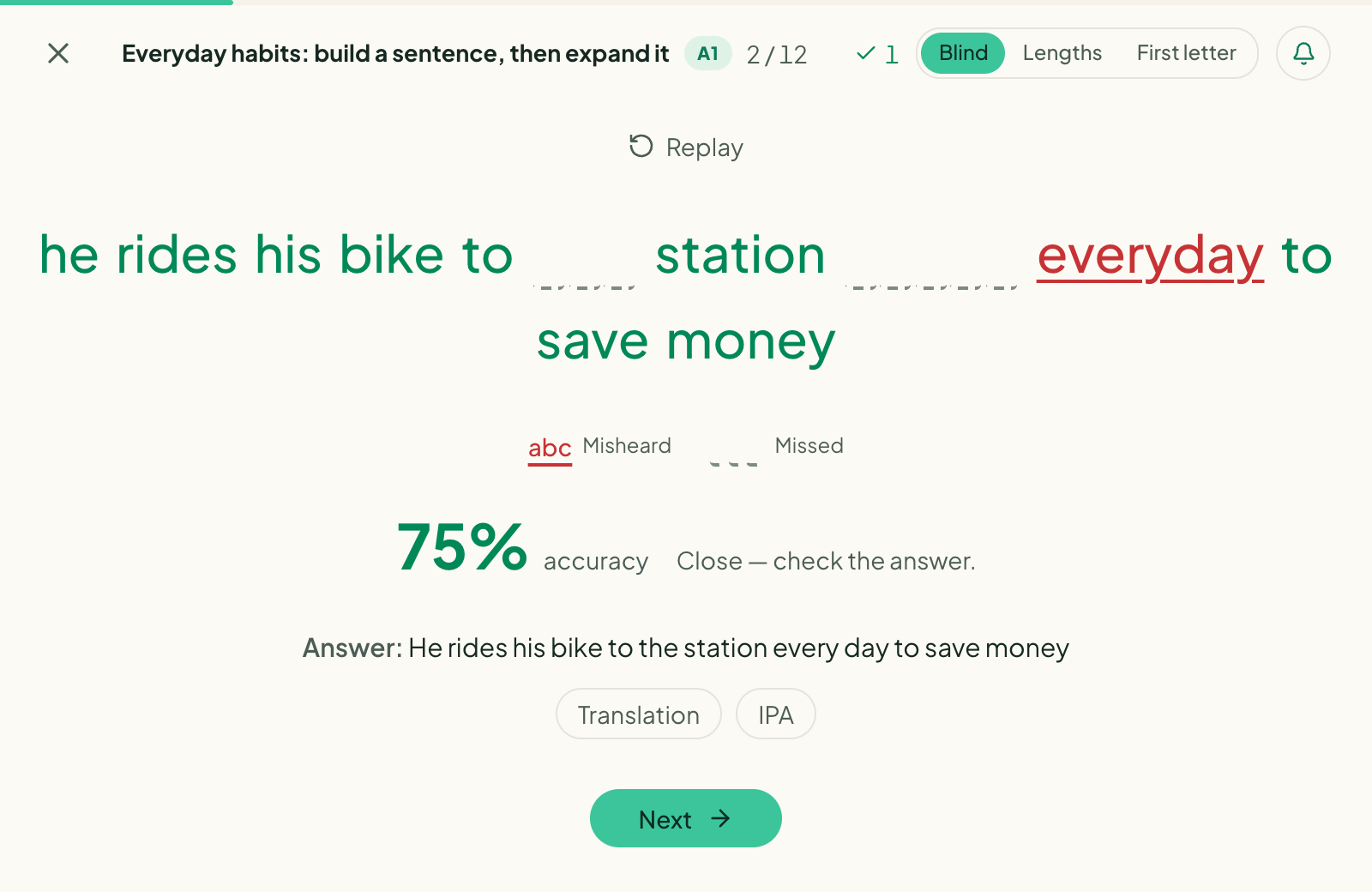
What we counted
- 325 learners from 64 countries (the largest groups: Vietnam, the United States, Thailand, Korea)
- 14,039 sentences, 90,584 words graded, July–October 2026
- 12,932 mistakes, split like this:
| Mistake type | Count | Share |
|---|---|---|
| Missing — nothing written | 5,312 | 41% |
| Misspelled — right word, wrong spelling | 4,348 | 34% |
| Misheard — a different word written | 3,272 | 25% |
We left out number words (one, seven, twenty…), because a learner who types "7" for seven heard it perfectly. The full method and its limits are at the end.
Finding 1: the most-missed words are the smallest ones
Here are the ten words with the most mistakes:
| Rank | Word | Mistakes |
|---|---|---|
| 1 | is | 509 |
| 2 | the | 454 |
| 3 | a | 415 |
| 4 | it | 329 |
| 5 | to | 260 |
| 6 | in | 210 |
| 7 | you | 200 |
| 8 | I | 199 |
| 9 | and | 171 |
| 10 | are | 160 |
Not one of them is a word anybody would look up in a dictionary.
Zoom out and the pattern holds. The 100 most common words in our sentences make up 65% of everything learners heard — and they account for 51% of all mistakes. Half of what goes wrong in listening happens on words a beginner already "knows".
That is the answer to the subtitle moment. You do know the words. You know them written. In speech, is, the, a and to are rarely pronounced the way they look: they shrink to a quick unstressed sound and glue onto their neighbours. Your ear is listening for a word that, in that form, never arrives. (Why you can't hear English walks through the three sound changes responsible.)
Finding 2: short words vanish, long words get misspelled
Short words and long words fail in completely different ways.
| Word length | Mistake rate | Most common mistake |
|---|---|---|
| 1–4 letters | 11–13% | missing (about half) |
| 5–6 letters | 15–18% | misspelled starts to lead |
| 7 letters | 22% | misspelled |
| 8+ letters | 30% | misspelled (46%) |
A long word is more likely to go wrong — but when it does, the learner usually heard it and just couldn't spell it. A short word goes wrong less often, but when it does, it is usually gone: for words of three letters or fewer, 54% of mistakes are a blank where the word should be.
And because short words are everywhere, they produce far more mistakes in total. Two different problems, two different fixes:
- Long words are a spelling and vocabulary problem. Flashcards and reading help.
- Short words are a listening problem. No amount of reading fixes them, because you can already read them.
Finding 3: in real speech, half the mistakes are words never heard
Most of our sentences are short, clearly read lesson sentences. But learners also import their own YouTube videos — interviews, podcasts, vlogs — and practice those sentence by sentence. Comparing the two is telling:
| Lesson sentences | Real YouTube speech | |
|---|---|---|
| Words graded | 67,512 | 23,072 |
| Mistake rate | 10.7% | 24.8% |
| Share that were missing | 32% | 52% |
In natural speech, the mistake rate more than doubles — and more than half of the mistakes are words that simply disappeared. The most-missed words in YouTube videos? the, a, I, to, is, and, you, it. The same list as before, only worse.
(Fair caveat: the videos people import also tend to be harder overall, so not all of the jump is "natural speech" alone. But the shift toward missing words is exactly what you'd expect when the small words get reduced even further.)
Finding 4: the confusions that keep repeating
Misheard words — where a learner wrote something else — fall into a handful of patterns that came up again and again:
| The speaker said | Learners wrote | Times |
|---|---|---|
| a ↔ the | the other article | 150 |
| every day | everyday | 37 |
| let us | let's | 31 |
| too | to | 28 |
| you are | your | 19 |
| any more | anymore | 18 |
| here | hear | 13 |
| what is | what's | 12 |
| know | no | 8 |
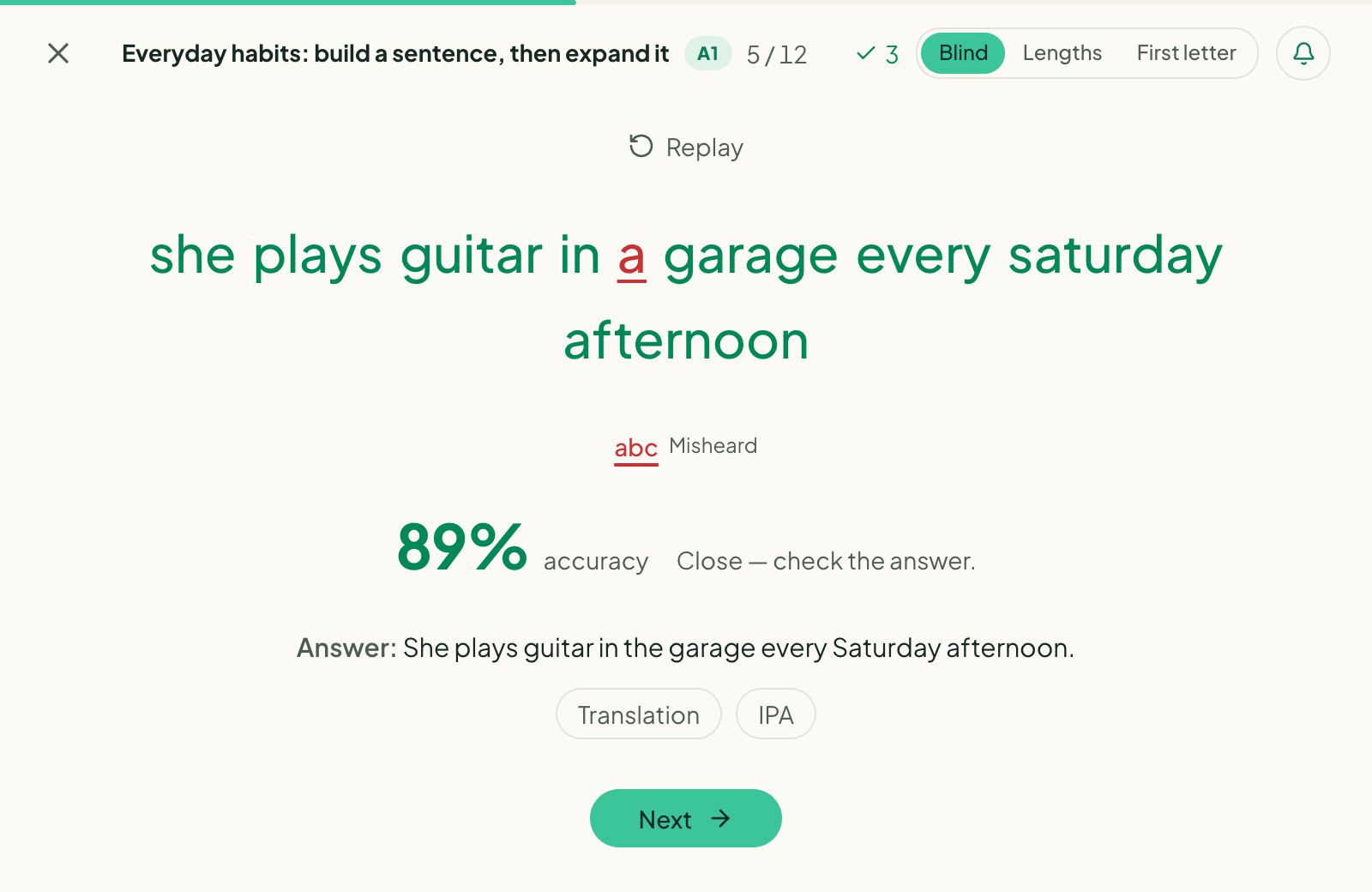
A few things stand out:
- a and the are interchangeable to the ear. In normal speech both shrink to a quick, unstressed syllable that is easy to hear as the other, so learners fill in whichever one feels grammatical. This is the single most common confusion in the data.
- Learners hear contractions that aren't there. Let us becomes let's, what is becomes what's, you are becomes your. The brain has learned that fast speech contracts, and over-applies it.
- Homophones need context, not ears. Too/to, here/hear, know/no sound identical. Getting them right is about understanding the sentence, which is why they cluster at the end of a learner's progress, not the start.
What to do with this
1. Count the small words on purpose. When you replay a sentence, don't listen for meaning — count the words. If the transcript has eleven and you heard nine, the missing two are almost certainly on the list above. Dictation forces this by design; it is the reason it works when "just listening" doesn't. (A 15-minute dictation routine shows how to structure it.)
2. Learn what the small words sound like, not what they look like. To is usually "tuh". And is usually "n". Are often merges into the word before it. Once you know the reduced forms, you start hearing them — the list is short.
3. Treat long-word mistakes as spelling, not listening. If you heard the word but couldn't spell it, the fix is a word list, not more audio.
4. Step up to real speech once lessons feel easy. A rough rule of thumb: when you score around 90% on lesson sentences, your ear is ready for more. Real speech is where the small words get hardest — and it is the speech you actually want to understand. (How to pick a YouTube video for your level.)
How we counted, and the limits
- Each learner's most recent attempt at each sentence is counted. Learners who retried a sentence show their later, usually better attempt — so if anything, these numbers understate how often words are missed on the first listen.
- Number words are excluded, and so are extra words a learner added that were not in the sentence (663 cases).
- Most lesson sentences are short and at A1–B1 level; most learners are adult self-learners, with Vietnam the largest single group. This describes our learners, not all English learners.
- This is a usage analysis, not a controlled study. The exact percentages will differ for other learners and other material.
Try it on yourself
The fastest way to find your own missing words is to dictate a few sentences and look at what disappears. You can start a free lesson at your level without signing up, or turn a YouTube video into a lesson and practice it sentence by sentence — every answer comes back graded word by word, just like the example above.